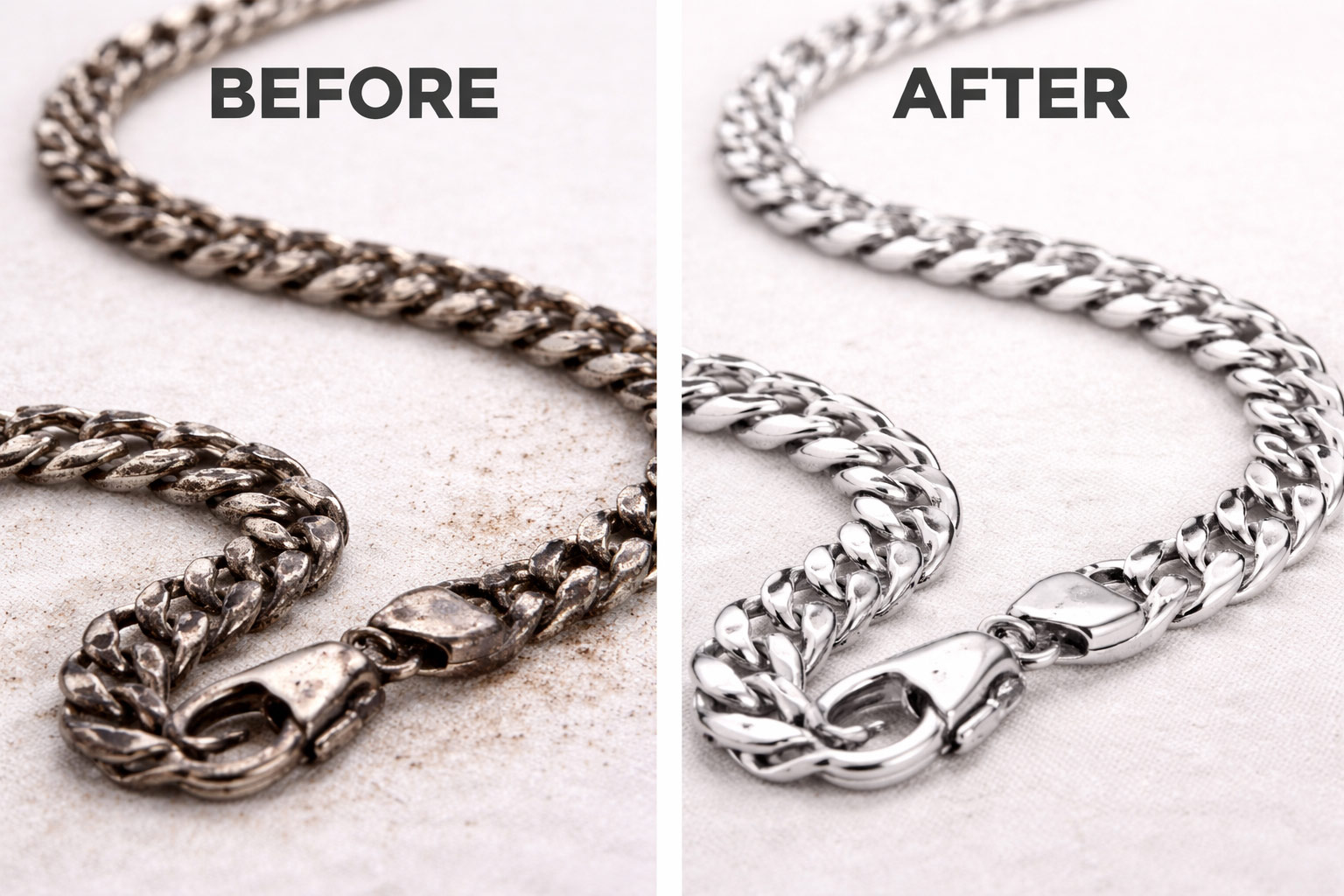
At Re:Lab in Trowbridge, ultrasonic cleaning is used for items that collect dirt in places that cloths, brushes and standard washing cannot reach. This includes tight gaps, hinges, settings, grooves, threads and porous surfaces. Instead of heavy scrubbing, we use a controlled ultrasonic process that lifts contamination from the structure of the item itself.
Ultrasonic cleaning is not just “shaking dirt off”. It works through a physical process called cavitation. Tiny bubbles form in the cleaning bath and collapse against the surface of the item. That action removes fine dirt, skin oils, soap residue, oxidation, grease and hidden build-up from areas that are too small for manual cleaning.
Most cleaning methods work only on the surface. A cloth wipes what you can see. A brush works only where the bristles can reach. Strong chemicals may loosen dirt, but they still do not solve the problem of hidden contamination inside tiny spaces.
Ultrasonic cleaning is different because the cleaning action happens inside the details of the object. The process reaches into narrow joints, under settings, around hinges and into textured surfaces. That is why it is so effective for precision items. Re:Lab’s approach is based on minimal intervention – using physical cleaning processes where possible to reduce mechanical friction and unnecessary wear.
A lot of valuable items are not actually “worn out”. They are blocked by residue, grease, oxidation or compacted dirt. Once that contamination is removed properly, the item often looks better, works better and lasts longer.
This is why ultrasonic cleaning matters. It is not only about appearance. It is about restoring function, hygiene and precision. For many small and delicate items, this is the safest way to clean deeply without aggressive scrubbing. Re:Lab’s whole operating model is built around restoring items instead of replacing them, using engineering-led cleaning methods that are effective but controlled.
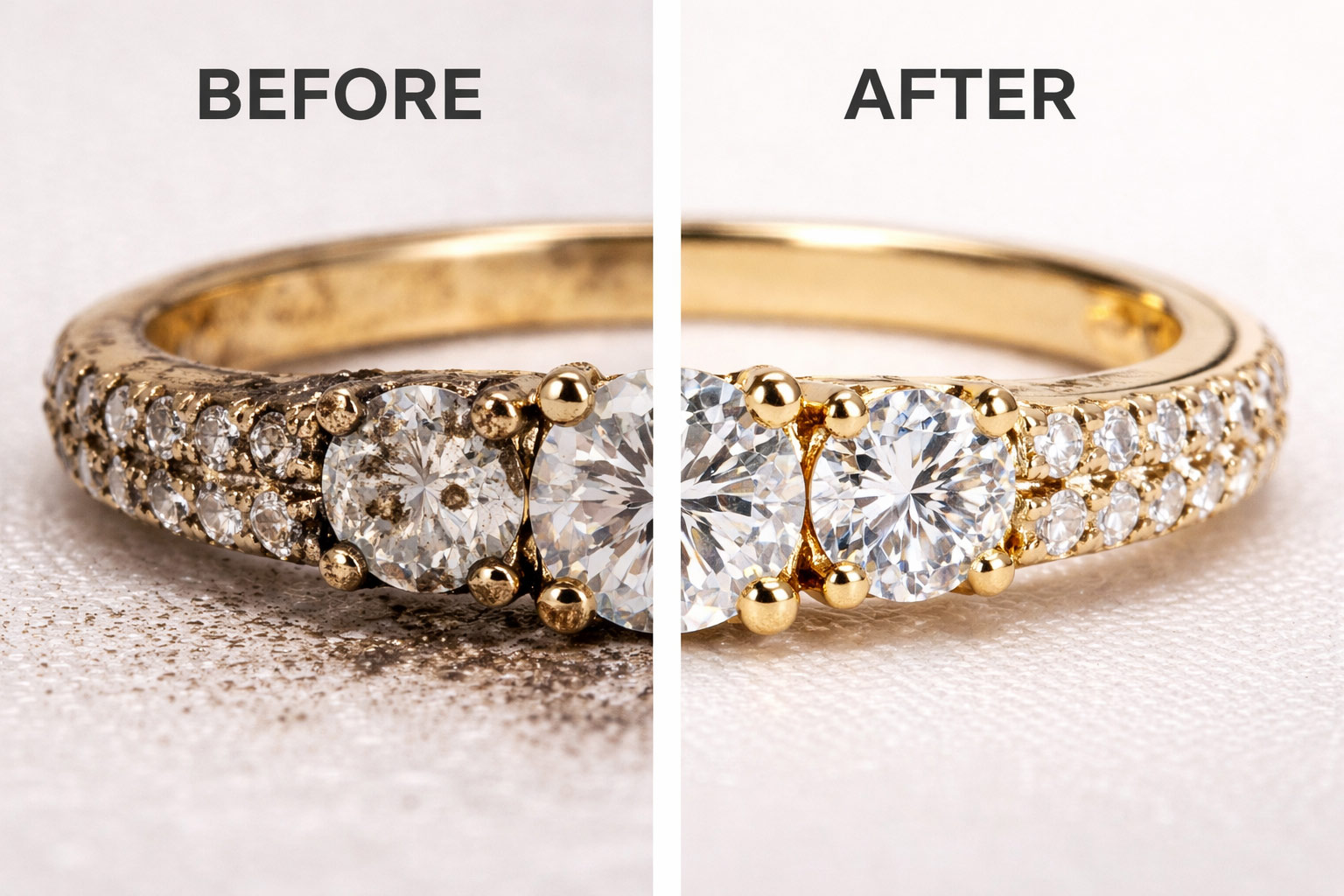
Standard cleaning and ultrasonic cleaning do not do the same job. Hand cleaning is useful for simple surfaces. Ultrasonic cleaning is for complex structures. Manual cleaning depends on pressure, friction and access. Ultrasonic cleaning depends on cavitation, so it can work in spaces that the human hand cannot physically reach. In many cases, this means a more complete clean with less rubbing, less force and less risk of surface damage from repeated scrubbing. That “no-touch” or low-contact logic is one of the core strengths of the Re:Lab method.
At Re:Lab, ultrasonic cleaning is never treated as a generic wash. We assess the type of item, the kind of contamination and the safest process for the material. Your documentation makes this clear: the goal is always minimal intervention and a method that puts the least stress on the object while still achieving a deep clean.
That matters because not every item should be cleaned with the same force, the same chemistry or the same process time. Precision cleaning works best when the method is matched to the structure of the item.
Many customers come to Re:Lab because they have an item that still has value but no longer feels clean, presentable or usable. A ring looks dull. Glasses collect residue around the hinges. A component is blocked with grease. A collectible has years of dust in the detail.
That is where ultrasonic cleaning makes sense. It is a restoration process, not a quick wipe-down. It helps recover condition, detail and hygiene without unnecessary abrasion. This fits the wider Re:Lab philosophy: don’t throw it away if the structure can still be restored.
If you are looking for ultrasonic cleaning in Trowbridge, Re:Lab offers precision cleaning for jewellery, glasses, watches, technical parts and hard-to-clean detailed items. Bring the item in for assessment and we will advise whether ultrasonic cleaning is the right process for its material, structure and contamination type.
We use ultrasonic cleaning for a wide range of small, detailed and hard-to-clean items.
Ultrasonic cleaning is ideal for:
This helps remove dirt from settings, links and fine details that are difficult to clean by hand.
Glasses and optics:
This is especially useful where green residue, skin oils and hidden dirt build up around the frame.
Technical and mechanical parts:
Your documentation also includes filters, atomiser parts, laboratory accessories and manufacturing components where very accurate degreasing matters.
At Re:Lab, ultrasonic cleaning can also be used for:
These are exactly the kinds of items where hidden residue collects in edges, grooves and contact points.